
The information in this article applies to any organisation using Dynamics 365 to process cross–border SWIFT payments or SEPA credit transfers where vendor addresses are currently stored as free text. If that describes your setup, the November 2026 deadline requires action on three fronts, and the window to act is shorter than most organisations currently realise.
The ISO 20022 update specifically addresses how vendor and beneficiary postal addresses must be structured within payment messages. Free–text, unstructured address fields – the kind that most ERP systems have stored for years – will no longer be accepted after November 2026.
This affects a broad range of payment types, including cross–border SWIFT payments and SEPA credit transfers. If your payment instruction includes an address, that address must be correctly structured – with at minimum a Town Name and Country Code in dedicated fields.
November 2026 is not a soft target. From that month, banks will stop accepting payment messages that contain unstructured addresses, and payments that do not meet the new standard will be rejected.
This is where many organisations are at risk of underestimating the scope of the work. There are three distinct elements that all need to be in order before November 2026:
Updating the bank format alone is only half the task at best.
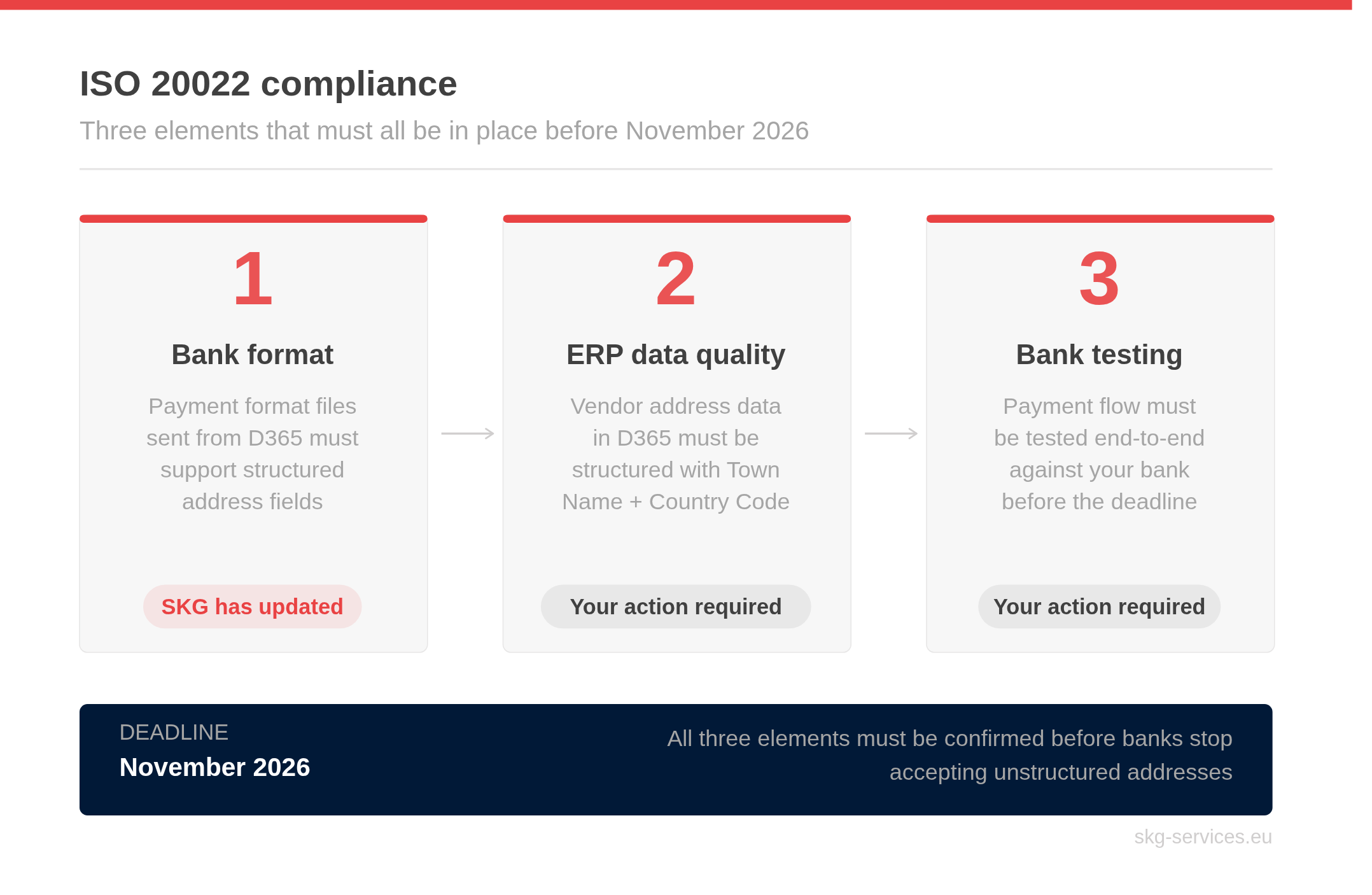
We see again and again that it’s assumed that the ERP data is OK as it is, and that the bank format should “just be working as–is”, and that a copy–paste like approach can be used. Reality is that a successful payment flow will always require three components working together; Quality Data, Payment Structure (aka Bank Format), and a Successful Testing. But if those elements are in place the first time, then you can save yourself a lot of time.
Pia Berg, Senior Functional Solution Architect, SKG Services Europe
The volume of vendors in your system matters significantly here. A company with 50 vendors faces a manageable data review. A company with 5,000 vendors is looking at a substantially larger exercise – and the data quality challenge scales accordingly.
This is not a hypothetical concern. A survey conducted by Zanders, published via Treasury Management International, found that 52% of respondents reported a high impact from having to restructure address data for ISO 20022 compliance, with a further 26% reporting medium impact. The data cleanup task is one of the most consistently underestimated elements of this migration.
Our customer base consists of medium to global organizations – and for all of those, the data proves that it is critical to be on top of these things. But of course, the bigger the volume of Vendors and payments, the bigger a mess you could be in after November 2026, if your payments get rejected. For any size corporation though, I would always recommend being proactive.
Jonas Andersen, CEO, SKG Services Europe
SKG Services Europe has proactively updated hundreds of bank formats across European banks ahead of the November 2026 deadline. This means that for many of our customers running our Banking and Treasury Automation Suite on D365, a significant portion of the technical groundwork is already in place.
If you are not yet a customer, that groundwork is available to you too. Our Advisory Assessment is open to any organisation running payments on Dynamics 365, regardless of your current setup.
However, this does not mean your payments are automatically compliant. We cannot guarantee that every bank format and payment specification has been covered. The address data in your ERP system is unique to your organisation – and only you can verify and correct it. Once data is in order, your payment scenarios must be tested against your bank.
Your involvement is not optional. It is a required part of ensuring your payments will run without disruption after November 2026.
As part of our Advisory Services, SKG Services Europe offers a structured ISO 20022 readiness assessment for D365 customers. It begins with a review of the bank formats and payment specifications currently in use – giving you a clear picture of where you stand and what, if anything, needs to change.
If a format update is required, we retrieve the latest specification directly from the relevant bank, together with you, and apply the necessary changes. The technical update of a bank format typically takes two to three weeks. If your organisation works with multiple banks across different countries, each format needs to be reviewed and potentially updated individually – so early engagement is important.
Following any format update, payments should be tested against the bank to confirm everything runs correctly before the November 2026 deadline. We can assist with this end–to–end, and have done so with numerous customers already.
Many treasurers I speak with assume the November 2026 deadline is primarily a technical concern – something for IT to handle. In practice, the payments that get rejected will land squarely on the finance team’s desk. An upfront, independent assessment of where your payment data and bank formats stand today is the difference between a controlled update and an operational crisis.
Lone Kejser, Treasury Advisor, Advisory Services – Managing Director, Skysparc
We will be able to tell you pretty quickly if there are certain payments, banks, or countries for your specific setup, where you can expect to have challenges or need to make updates – and based on that, we can then make a plan together. It’s better to make that plan now, than in Q3 2026… Then you will be putting out fires.
Pia Berg, Senior Functional Solution Architect, SKG Services Europe
Our Advisory Services span the full banking and treasury lifecycle – from compliance readiness and scoping workshops to solution health checks and roadmap planning.
Before November 2026, three things need to be confirmed:
If you cannot confirm all three, now is the time to act.
If you are running payments out of Dynamics 365 and are unsure whether your bank formats or ERP data meet the new ISO 20022 requirements, reach out to us now – ahead of November 2026.
We will review your current bank formats and payment specifications, identify what needs to be updated, and support you through testing. The earlier you engage, the more time we have to ensure your payments run smoothly after the deadline.
The work required is real – but organisations that address it now will operate with a cleaner, faster, and more reliable payment infrastructure on the other side of it.
Ready to Automate Your Financial Operations?
Schedule a conversation to see how secure automation can improve efficiency and accuracy for your banking and treasury transactions.